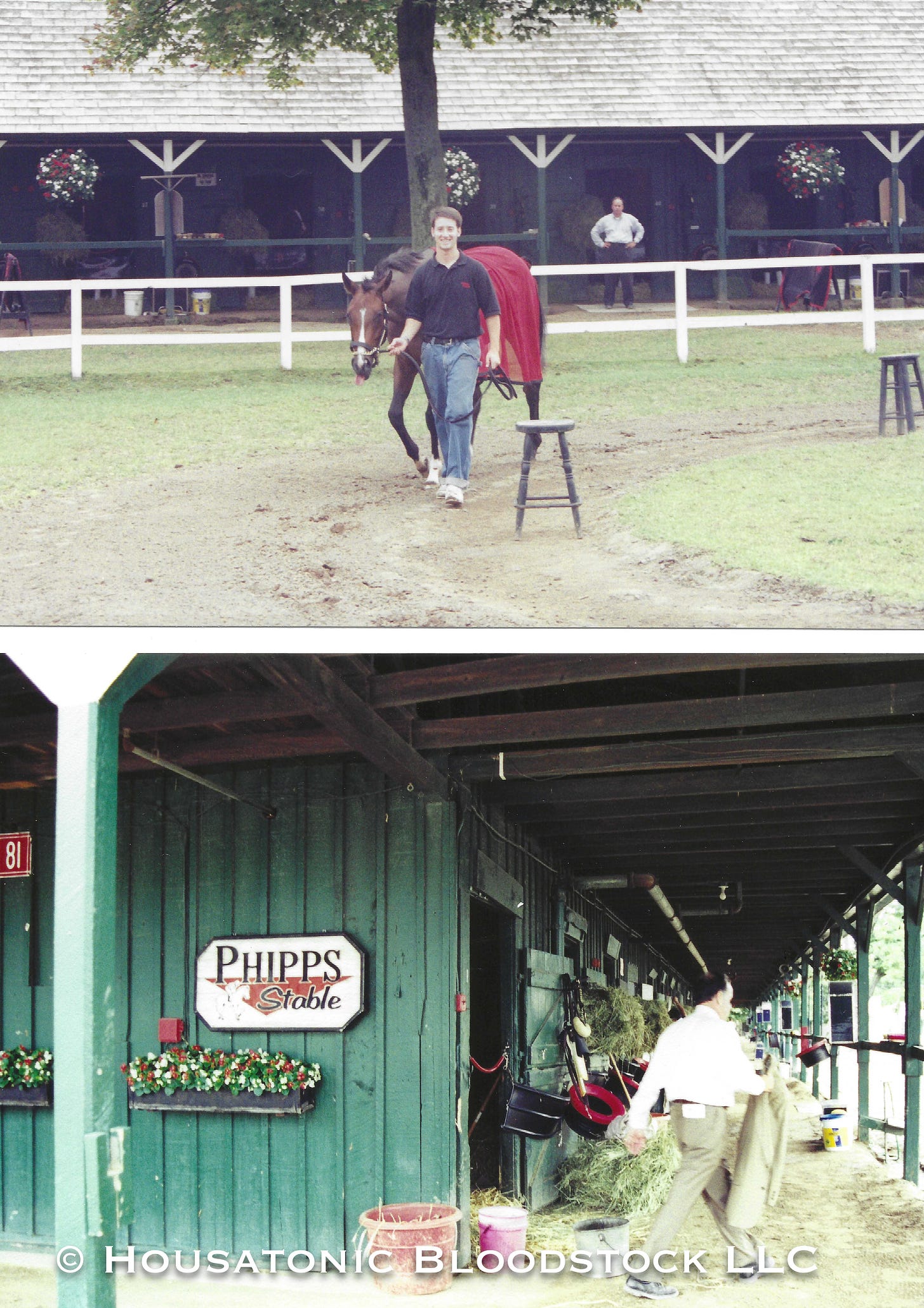
As we mentioned a few posts back in our recap of Golden Tempo’s Kentucky Derby victory, we have long been fans of the Phipps Family’s breeding and racing operation, and got our start in the racing industry as a hot-walker for trainer Shug McGaughey specifically because he was the trainer for the Phippses. As has been well-documented recently, the Phipps Family’s model has changed in the past decade or so, and they no longer breed on the scale that they used to, nor do they do so with the express expectation of racing all their own homebreds.
But Golden Tempo’s win in the Kentucky Derby, which he followed up with success in the Belmont Stakes (albeit carrying someone else’s silks), has led us to pull out some volumes from our library that document the Phipps Family’s previous periods of sustained success. Among that recent reading material was the chapter in Abram Hewitt’s “The Great Breeders and Their Methods”1, in which he spends most of his words on the Wheatley Stable Blue Hen mare Grey Flight (whom Hewitt bred and sold as a yearling), and then the great racehorses and sires Bold Ruler and Buckpasser, including the failure of mares by the former to click with the latter. Hewitt’s winds up his Phipps chapter by noting:
Doubtless, Ogden Phipps will seek a suitable cross for both his Bold Ruler and Buckpasser blood. This is not altogether easy in the U.S., as he already has the best strains of blood in the names of *Nasrullah, Bold Ruler, *Princequillo, and Buckpasser in profusion in his stock.
We thought it might be fun to take a look at what suitable crosses Ogden Phipps (and the rest of his family, who we will group together as “the Phipps Family” for purposes of this post) found for those Bold Ruler and Buckpasser mares.
The Phipps Family (in this case encompassing Ogden Phipps, his mother’s Wheatley Stable, and his children Ogden Mills “Dinny” Phipps and Cynthia in their own names) was responsible for breeding 29 stakes winners out of Bold Ruler mares. Just two of those were sired by Buckpasser, namely the British classic winner Quick As Lightning (out of Clear Ceiling) and the minor stakes winner Quick Turnover (out of Bold Consort), while 18 other stallions were responsible for at least one Phipps-bred stakes winner out of a Bold Ruler mare. Of those 18 stallions, only four (in addition to Buckpasser) sired more than one such stakes winner: Forli, Herbager, Majestic Light, and Tatan.
Argentine Quadruple Crown winner Forli sired five stakes winners for the Phipps Family out of Bold Ruler dams, three of which were full-siblings out of In Hot Pursuit: Posse (a G1 winner in Britain), German G3 winner Hot Rodder, and U.S. G3 winner Late as Usual. Freedom’s Choice (out of Full of Hope, and a full-brother in blood to Posse, Hot Rodder and Late as Usual, as their dams were full-sisters) was an Italian G3 winner, while Intrepid Hero (out of Bold Princess) was a multiple G1 winner in the U.S.
The French import Herbager sired G1 winner Landscaper (out of My Boss Lady) and G3 winner Flitalong (out of Pleasant Flight) (and Herbager’s son Grey Dawn II sired champion Christmas Past out of Bold Ruler’s daughter Yule Log). Another Argentinian, Tatan, got Bright Sun (out of Beautiful Day) and Predictable (out of Bold Princess), while the Phipps homebred Majestic Light was responsible for G3 winner Erin Bright (out of Irish Manor) and the full-sisters Stratospheric (a British G3 winner) and Infinite (both out of Clear Ceiling).
Interestingly, of the 29 stakes winners that the Phipps Family bred with Bold Ruler as the broodmare sire, more than half (16) achieved their highest racing status on turf (though the two of the highest class, champions Christmas Past and Autobiography, were dirt horses).
This propensity for turf could tie in to Hewitt’s observation that Bold Ruler tended to pass along a degree of unsoundness, as grass racing is known to be easier on horses than dirt. And whatever the cause of it, this turfiness and the distance capabilities that tended to come with it were not conducive to the type of success that the Phipps Family sought.2
Buckpasser might not have had as much success as Bold Ruler did as a sire (including when crossed with Bold Ruler’s daughters), and he might not have been the broodmare sire of as many stakes winners for the Phipps Family as Bold Ruler was, but Buckpasser — through his daughters — had a much greater impact on the Phipps Family’s breeding operation than Bold Ruler did in the period following Hewitt’s article.
Indeed, Buckpasser sired only seven stakes winners for the Phipps Family while his daughters produced just 18 stakes winners for them (compared to 36 and 29, respectively, for Bold Ruler and his daughters). But that former group included champion Relaxing and G1 winners Quick As Lightning, Squander and Numbered Account, while the latter featured champion Easy Goer and no fewer than eight more G1 winners.
The 18 stakes winners that the Phipps Family bred from Buckpasser’s daughters were sired by 13 different stallions, with five sires each responsible for a pair of them: Alydar sired Easy Goer and his G1-winning full-sister Cadillacing (out of Relaxing), Damascus sired G1 winner Private Account (out of Numbered Account) and On Retainer (out of Ten Cents a Dance), Danzig sired G1 winners Easy Now (out of Relaxing) and Versailles Treaty (out of Ten Cents a Dance), Mr. Prospector sired G1 winners Seeking the Gold (out of Con Game) and Mining (out of I Pass), and Seattle Slew sired G1 winner Fast Play (out of Con Game) and G3 winner Serious Spender (out of Squander).
Unlike the majority of the Phipps Family’s stakes winners from Bold Ruler’s daughters, only three of the 18 out of Buckpasser dams scored their stakes victories on turf — and those three were sired by the likes of French import Le Fabuleux, British Triple Crown winner Nijinsky II, and turf horse Topsider. Indeed, this low percentage came despite success being obtained with stallions like Danzig, Majestic Light (whose stakes winner out of a Buckpasser mare scored on dirt, while two of this three stakes winners out of Bold Ruler mares scored those wins on turf), Mr. Prospector and Northern Dancer, whose offspring all had plenty of (if not predominantly) success with their offspring on turf.
Interestingly, given our original prompt for this post, two of the Phipps Family’s stakes winners out of Buckpasser mares had second dams by Bold Ruler (Waitlist was by Avatar out of Renounce, out of Bold Princess, and G2 winner Fabulous Time was by Le Fabuleux out of Her Prerogative, out of Queen of the Stage), while G3 winner Comptroller was bred on the reverse cross observed negatively by Hewitt, being by Bold Ruler’s son Reviewer (and out of Bank of England).
It Takes Two…

One other quote that we’ve come across variations of is this one attributed to Dinny Phipps, relating to the importance of its female runners to the Phipps Family’s accomplishments in racing:
I have an affinity for the fillies. We are not big buyers at sales; we are breeders of our own horses, and therefore our fillies have to produce on the track or we don’t have the ability to win in the future. So our fillies are the most important thing that we have. They are our foundations, for my children, and for the future.3
Obviously there is truth to this statement, which was borne out yet again by the success of Golden Tempo, whose first five dams were all bred by the Phipps Family. But in reviewing a list of the 323 stakes winners bred by the Phipps Family through their 2011 crop, 95 of them — so almost 30% — were sired by a stallion that the Phipps Family also raced, and fully 80 were by stallions that they also bred (and raced).
Their 47 stakes winners sired by Bold Ruler and Buckpasser discussed above obviously count towards these totals, but more recently the likes of Easy Goer (sire of two Phipps Family-bred stakes winners, both G1 winners in Furlough and My Flag), Majestic Light (five), Private Account (eight, including champions Inside Information and Personal Ensign, plus G1 winner Personal Flag), Seeking the Gold (seven, including champion Heavenly Prize and G1 winners Pleasant Home, Oh What a Windfall (a full-sister to Heavenly Prize) and Secret Savings), and Time For a Change (two) have made major contributions to the Phipps Family’s homebred success. So while the fillies certainly plan an integral part in the Phipps Family’s success, this seems like the rare time that the stallions maybe deserve more credit than they’re being given for their contribution (though of course, if they were homebreds, then their dams were pretty important to the program as well).
And you’ll note that Easy Goer, Private Account and Seeking the Gold are all out of Buckpasser mares, to tie back into the ongoing influence that he maintained over the Phipps Family’s breeding operation post-Hewitt.
Published in 1982 from articles that had previously appeared in The Thoroughbred Record.
Dinny admits he went astray: “I was concerned — much more than my father — that we were breeding too much speed with the Bold Rulers. So I tried breeding sprinting mares {mostly daughters of Bold Ruler} to long-distance stallions. And what I got were horses who couldn’t run very well.” The Phipps’ horses were typically late-blooming distance runners, and the family hired trainers, such as Angel Penna, who were oriented toward developing horses of that very type. And that’s not the way to achieve consistent success in speed-oriented American racing.